Nakhon Pathom: The Town That Is Older Than Bangkok
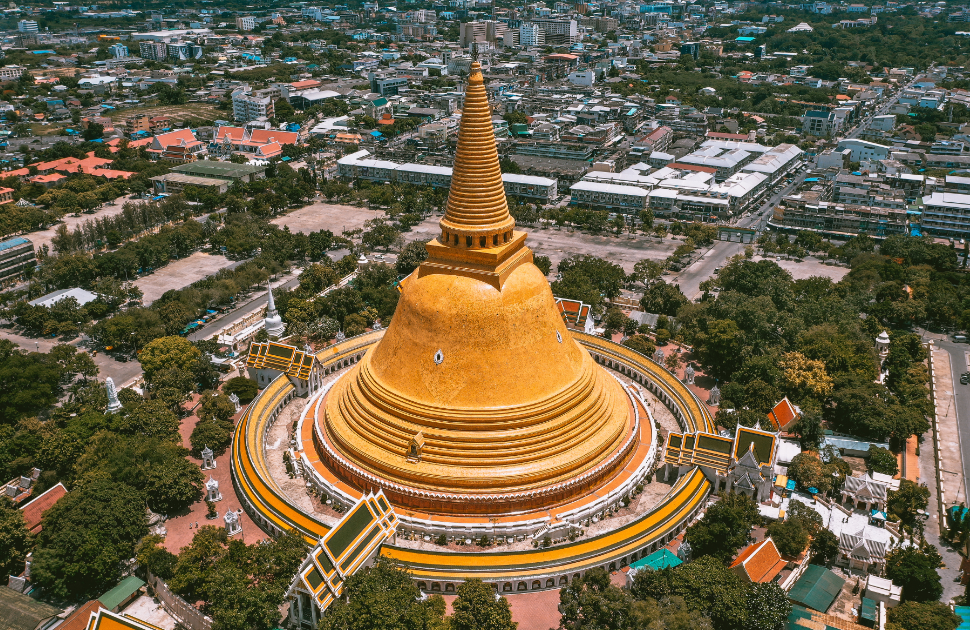
The first time you see Phra Pathom Chedi rising from the flat central plains, 56 kilometers west of Bangkok, you understand why this place became sacred long before Ayutthaya was even imagined. The massive orange dome, 120 meters tall and visible from every direction, anchors a town that has been welcoming pilgrims, traders, and curious visitors for over a thousand years. Bangkok, by comparison, is barely an adolescent.
Most people visit Nakhon Pathom as a day trip from the capital, tick off the temple, eat lunch, and return on the evening train. They miss the point entirely. This is not a tourist destination with convenient opening hours. This is the place where Buddhism first took root in what we now call Thailand, where you can walk through layers of history that predate everything you think you know about this country.
The Oldest Buddhist Monument in Thailand
Phra Pathom Chedi is not just old. It is the oldest Buddhist monument in Thailand, built on a site that has been continuously sacred since the 6th century. The current structure, completed in 1870 under King Mongkut, encases an earlier Khmer prang that itself covered the original Mon stupa. Three civilizations, three architectural styles, one unbroken thread of devotion.
Walking the marble galleries that circle the base, you pass Thai families making merit, elderly Chinese immigrants burning incense, and monks in saffron robes who treat this place not as a museum but as a living center of practice. The tourist groups from Bangkok arrive in air-conditioned buses, photograph the golden Buddha images in the four cardinal directions, and leave within an hour. The locals arrive at dawn, circumambulate the chedi three times in bare feet, and stay until the evening chanting begins.
The chedi contains relics of the Buddha himself, though which relics and how they arrived here remains a matter of scholarly debate and local legend. What is not debated is the power this place holds over the Thai religious imagination. Every Thai king since Mongkut has contributed to its restoration and expansion. Every serious student of Thai Buddhism makes pilgrimage here at least once.
The Mon Kingdom That Time Forgot
Before there was a Thailand, before the Khmer built Angkor, this region was the heart of Dvaravati, a Mon kingdom that controlled the trade routes between India and China from the 6th to 11th centuries. The Mon people were the first in Southeast Asia to embrace Buddhism, and Nakhon Pathom, then called Nagara Pathama, was their spiritual capital.
You can see traces of this forgotten kingdom in the Phra Pathom Chedi National Museum, located in the temple complex. Dvaravati-period Buddha images, carved in the distinctive Mon style with their gentle expressions and flowing robes, line the walls alongside Sanskrit inscriptions that predate the Thai script by centuries. The museum is small, under-visited, and contains some of the most important Buddhist art in Thailand.
The Mon influence explains why Nakhon Pathom feels different from other Thai temple towns. The layout is circular rather than linear, following the ancient Indian mandala pattern. The local dialect contains Mon words that have disappeared elsewhere in Thailand. Even the food reflects this layered history: khao chae, the delicate rice-in-ice-water dish that Thai royalty adopted as summer cuisine, originated here among Mon nobles seeking relief from the central plains heat.
What Bangkok Cannot Teach You
Living in Bangkok, you learn Thai Buddhism as a urban practice: temples squeezed between shopping malls, monks collecting alms from street food vendors, meditation centers advertised on Instagram. Nakhon Pathom shows you what Buddhism looked like before Thailand became modern, before it became a nation-state, before it became a tourist destination.
The town operates on temple time, not business time. Shops close at sunset. Restaurants serve whatever the local market provided that morning. The evening chanting at Phra Pathom Chedi draws hundreds of locals who arrive with folding chairs and thermos flasks of tea, settling in for hours of meditation and prayer. This is not a performance for visitors. This is how Buddhism actually works when it is allowed to work naturally.
I have brought Bangkok friends to Nakhon Pathom who complained about the lack of good coffee shops, the early closing times, the absence of nightlife. They missed the point. Nakhon Pathom is not trying to be convenient for modern life. It is trying to preserve something that modern life tends to erode: the rhythm of contemplation, the weight of genuine antiquity, the possibility that some places should remain unchanged.
The Train Journey That Matters
The State Railway of Thailand runs regular services from Bangkok's Thonburi station to Nakhon Pathom, a journey of 90 minutes through rice fields, market gardens, and small towns that have not yet been swallowed by suburban development. The third-class carriages cost 31 baht. The windows open. Vendors board at each station selling fresh fruit, grilled squid, and coffee in plastic bags tied with rubber bands.
This train journey is part of the pilgrimage. It forces you to slow down, to watch the landscape change gradually from urban to rural, to arrive in Nakhon Pathom in the proper frame of mind for encountering something genuinely ancient. The bus is faster. The train is essential.
From Nakhon Pathom station, the chedi is visible as soon as you step onto the platform. No taxi required, no navigation necessary. You follow the dome like a compass, walking through streets where wooden shophouses sell Buddhist amulets, incense, and lotus flowers by the armload. This approach, on foot, through the living town, is how pilgrims have arrived here for centuries.
The Weight of Real History
Thailand markets itself as the Land of Smiles, the exotic kingdom, the spiritual retreat. Most of this is marketing. Nakhon Pathom predates the marketing by a millennium. Here, the spirituality is not packaged for international consumption. The history is not simplified for tour groups. The town simply continues, as it has continued, regardless of whether the outside world pays attention.
Standing in the evening light beneath Phra Pathom Chedi, listening to the chanting that has echoed here for over a thousand years, you realize that Bangkok, for all its energy and opportunity, is still learning how to be Thai. Nakhon Pathom already knows.